Kadagv's mock imprisonment
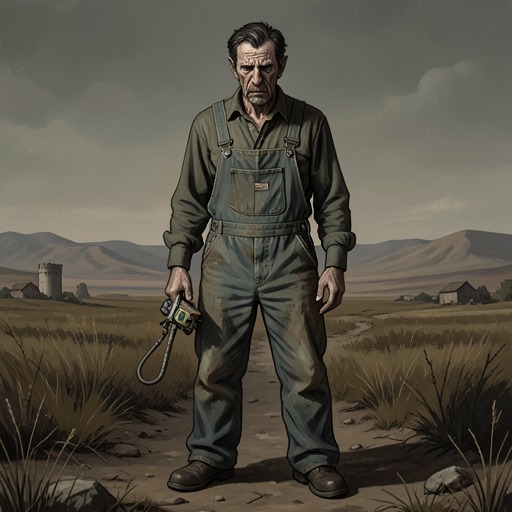
The DispossessedKadagv's mock imprisonment begins as a game of perversity and ends as a concrete encounter with the power to confine another person. Beneath the learning center, a group of boys constructs a cell that cannot be opened from within; when Kadagv volunteers to enter it, he insists that his captors—not the prisoner—must decide when he is released. The experiment lasts about thirty hours, exposes the distance between imagining imprisonment and enduring it, and leaves Shevek physically ill after he helps free Kadagv.
The Cell and the Experiment
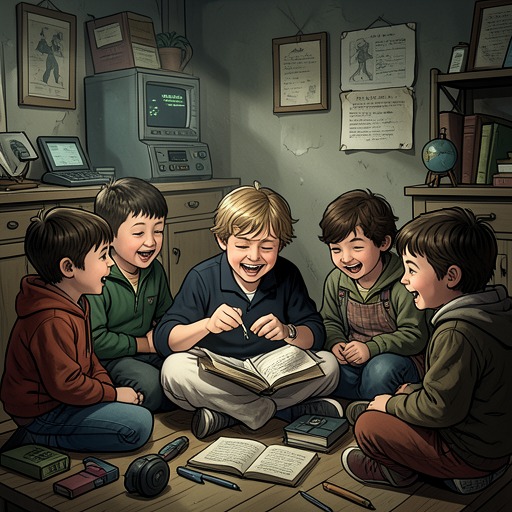
Tirin, Shevek, and three other boys are drawn together by what the narration calls the simple lure of perversity. Girls are excluded from their company, though the boys themselves could not have explained why. Tirin devises an ideal prison beneath the west wing of the learning center: a space just large enough for one person to sit or lie down, enclosed by three concrete foundation walls and the underside of the floor above. A heavy slab of foamstone siding serves as its door. Two props wedged between the slab and a facing wall make the closure final; nobody inside can open it.
The boys’ questions turn the construction into a rehearsal of imprisonment. There is no light in the cell, and Tirin invokes the prisoners kept in darkness at the Fort in Drio for years. His confidence comes less from what he knows than from the force of his imagination, which lets him place himself inside the conditions he describes. Yet imagining the cell does not satisfy everyone: Kadagv, a broad-chested, serious, domineering twelve-year-old, wants to experience it himself.
Tirin jeers at the idea, but the others support Kadagv. Shevek gets a drill from the workshop, and they spend nearly an hour boring a two-centimeter air hole through the slab at nose height. When the boys ask how long Kadagv should remain inside, he answers that a prisoner cannot decide: if he is the prisoner, he is not free, and the others must determine when to let him out. Shevek is unnerved by the logic. The distinction between voluntarily entering a game and having control over its ending has already begun to matter.
The Guards and Their Prisoner
Kadagv enters the cell, the slab is set in place with a bang, and all four jailers hammer the props into position. The boys crowd around the air hole, but the darkness prevents them from seeing their prisoner. As the game continues, the roles cease to feel merely performed. In a later encounter beneath the building, Kadagv turns to obey Tirin’s order to get into the cell, and Tirin pushes him hard in the back. Kadagv falls sprawling and scrapes or sprains a finger against the rear wall. Shevek and Tirin stand without speaking, their faces expressionless in their assumed roles as guards; the narration marks the reversal by observing that they are no longer playing the roles—the roles are playing them.
The younger boys return with holum bread, a melon, and a bottle of water. They shove the provisions into the cell and brace the door again, leaving Kadagv alone in the dark. Around the lantern, Gibesh asks where the prisoner will urinate. Tirin answers that he will do it in his bed; when Gibesh asks what will happen if he needs to defecate, he breaks into laughter. The bodily conditions of confinement intrude on the boys’ make-believe, making the cell less an abstract idea than a place where the prisoner must endure the consequences of the guards’ decisions.
After dinner, Gibesh, who has been on guard duty, tells Tirin and Shevek that he thinks he heard Kadagv speaking inside in a strange voice. Shevek says they will let him out. Tirin tells him not to become altruistic and argues that Kadagv should finish the ordeal and respect himself at its end. Shevek rejects that appeal: he wants to respect himself. He sets off for the learning center, and Tirin follows; the eleven-year-olds trail behind them.
Release and Aftermath
Under the building, Shevek knocks one wedge free and Tirin removes the other. The slab falls outward with a flat thump. Kadagv is curled on the ground. He sits up and rises slowly, stooping more than necessary beneath the low roof and blinking in the lantern light. He looks much as usual, but the smell from the cell is overwhelming: he has suffered diarrhea, leaving a mess inside and yellow fecal smears on his shirt. Seeing the stains in the light, he tries to hide them with his hand. The others say little.
On the way back toward the dormitory, Kadagv asks how long he has been inside. Shevek answers, “About thirty hours, counting the first four.” Kadagv calls that pretty long, though without conviction. The answer fixes the experiment’s scale: what began as a controlled test of a dark room has extended across a day and a night, with the prisoner unable to set its duration or conditions.
Shevek takes Kadagv to the baths to clean up, then runs to the latrine and vomits over a bowl. The spasms last a quarter of an hour, and he is shaky and exhausted when they pass. He reads some physics in the dormitory common room and goes to bed early. None of the five boys returns to the prison beneath the learning center. None speaks of the episode again, except Gibesh, who once boasts about it to older boys and girls; they do not understand, and he drops the subject.
Significance
The episode tests the boys’ ideas about freedom against the material fact of confinement. Kadagv’s rule—that the prisoner cannot decide when to leave—makes the asymmetry explicit before the door closes. Tirin’s confidence in imagining imprisonment, his command over the improvised cell, and his push against Kadagv expose how quickly a game can furnish real authority to those cast as guards. Once the roles take hold, the boys’ silence and the prisoner’s bodily distress replace the easy laughter of the initial experiment.
Shevek’s decision to release Kadagv is not presented as an abstract rejection of the experiment: he acts because remaining inside the guard role would violate his own self-respect. His later vomiting, while Kadagv is taken to wash, registers a bodily response to what the boys have done without turning that response into a public confession; the event remains largely unspoken among them. The abandoned cell and the group’s silence preserve the episode as a formative encounter with coercion, responsibility, and the difference between choosing an ordeal and having the power to end it.